Methanol is one of the chemical industry's most versatile building blocks, feeding formaldehyde (for resins and construction materials), acetic acid (for adhesives and packaging), MTBE (a gasoline blending component), methanol-to-olefins (MTO, a major route to ethylene and propylene in China), biodiesel production, and an emerging role as a marine fuel for decarbonizing shipping. Asia dominates global methanol trade, with China the world's largest consumer and a major importer, while India's industrial demand and import dependency continue to grow.
Traditional trade patterns anchored by Iranian and broader Middle Eastern supply into India, and Middle Eastern supply into China have been disrupted by sanctions on Iranian exports, Red Sea shipping diversions, and freight market volatility. In response, India has accelerated supplier diversification, while China has periodically emerged as an opportunistic exporter into India and Southeast Asia during regional supply shortages, a role reversal that would have been unusual a decade ago.
Mapping these evolving flows between China, India and the Middle East has become essential for commodity market participants, as route volatility increasingly drives price formation, arbitrage opportunities and procurement strategy across Asian methanol markets. This article examines the global trade map, China's and India's evolving roles, the key trade corridors, freight and geopolitical drivers, the emerging green methanol dimension, and the outlook through 2035.
1. The Global Methanol Trade Map
The Middle East led by Iran, Saudi Arabia, Oman and Qatar remains the backbone of seaborne methanol export supply, leveraging low-cost gas feedstock to serve both India and China. China itself is the world's largest producer, predominantly via coal-based methanol, with extensive coastal import infrastructure to bridge the gap between domestic supply and MTO-driven demand; its net trade position shifts depending on domestic operating rates and feedstock costs. Southeast Asian producers in Malaysia, Indonesia and Brunei supply both India and intra-regional markets, with Singapore serving as a key trading and blending hub. North American exporters US Gulf Coast and Trinidad & Tobago are oriented primarily toward Europe and Latin America but can participate in Asian arbitrage windows when economics align.
|
Export Region |
Key Producers |
Major Destinations |
Competitive Advantage |
|---|---|---|---|
|
Middle East |
Iran, Saudi Arabia, Oman, Qatar |
India, China, Southeast Asia |
Low-cost gas feedstock |
|
China (opportunistic) |
Coastal coal-based units |
India, Southeast Asia |
Spot surplus during demand troughs |
|
Southeast Asia |
Malaysia, Indonesia, Brunei |
India, intra-regional |
Proximity, established trade lanes |
|
North America |
US Gulf Coast, Trinidad & Tobago |
Europe, Latin America, occasional Asia |
Low-cost shale gas feedstock |
.png)
Chart 1: Asian Methanol Trade Flows (Illustrative)
2. China's Role in Asian Methanol Markets
Demand growth
China's methanol demand is dominated by the MTO sector, which converts methanol into ethylene and propylene and represents the largest single consumption category, alongside fuel-blending applications and broad-based chemical sector use including formaldehyde and acetic acid production.
Import dependence
Despite being the largest global producer, China has historically relied on imported cargoes particularly from Iran and the broader Middle East to balance its market during periods of strong MTO margins or domestic production curtailments. Sanctions-related disruptions to Iranian flows have periodically tightened these imports, prompting Chinese buyers to diversify sourcing.
Export emergence
When domestic coal-based production runs at high rates and MTO margins compress, China can develop a domestic surplus that finds its way into export markets. Recent cargo movements have seen Chinese-origin methanol move into India and Southeast Asia during periods when traditional Middle Eastern supply to those markets was constrained transforming China, on an opportunistic basis, from a net importer into a swing exporter that helps balance regional shortages.
.png)
Chart 3: China's Methanol Supply Balance, 2015-2035 (Million Tonnes, Illustrative)
3. India's Growing Dependence on Imports
Domestic production constraints
India's domestic methanol production capacity remains limited relative to demand, constrained by natural gas availability and allocation priorities that favor other gas-consuming sectors, leaving the country structurally reliant on imports to meet a large share of consumption.
Demand drivers
Growth in formaldehyde-based construction materials, pharmaceuticals, broader downstream chemicals, and emerging energy applications including methanol blending continue to expand India's methanol demand base, with import volumes rising correspondingly.
Supply diversification
India's import base was historically anchored by Iranian cargoes, reflecting favorable logistics and pricing. Sanctions-related disruptions and associated payment and shipping complications have accelerated a shift toward alternative suppliers, with imports from China, Russia, Southeast Asia and other Middle Eastern producers all increasing as India broadens its supplier base even as overall import volumes continue to rise.
|
Country / Region |
Illustrative Share (2025) |
Comments |
|
Saudi Arabia, Oman & Qatar |
30–40% |
Largest and most stable suppliers |
|
Russia |
10–15% |
Growing supplier following trade realignment |
|
Iran |
5–10% |
Limited by sanctions and payment restrictions |
|
Southeast Asia (Malaysia, Indonesia, Brunei) |
10–15% |
Regional suppliers with periodic shipments |
|
Trinidad & Tobago / Americas |
10–15% |
Long-standing global export hub; occasional supplies |
|
UAE & Other Middle East |
5–10% |
Supplemental regional supply |
|
Others |
10–15% |
Includes miscellaneous spot cargoes |
Table: India's Methanol Import Sources, 2025 (Illustrative)
4. Mapping the Trade Routes
Route 1: Iran → India
The traditional Iran-India corridor offered favorable freight economics given proximity, but has become increasingly exposed to political risk from sanctions enforcement, banking restrictions and shipping insurance complications, periodically disrupting volumes despite the route's underlying cost advantages.
Route 2: China → India
Opportunistic cargoes from Chinese coastal loading ports to India have emerged during export windows when domestic Chinese surpluses coincide with tight Indian import availability from traditional sources, with freight advantages from relatively short-haul intra-Asian voyages supporting the economics of these flows.
Route 3: Southeast Asia → India
Malaysian and Indonesian producers supply India directly, while Singapore's trading hub function allows cargoes to be redirected flexibly based on relative pricing, providing an additional buffer corridor when other routes are constrained.
Route 4: Middle East → China
China's reliance on Middle Eastern imports concentrates supply risk around the Strait of Hormuz; any disruption to this chokepoint has outsized implications given the volume of methanol (and broader energy and chemical cargoes) that transits it, illustrating how a single corridor disruption can rapidly reshape trade patterns across multiple Asian markets simultaneously.
5. Freight, Geopolitics and Arbitrage Economics
Freight market volatility
Clean tanker rates for methanol cargoes are sensitive to broader product tanker market conditions, voyage economics on key Asian routes, and port congestion at major loading and discharge terminals all of which can swing the relative attractiveness of competing supply sources within weeks.
Geopolitical risks
Strait of Hormuz tensions, Iran-related sanctions enforcement, and Red Sea shipping disruptions have each, at various points, raised shipping insurance costs and lengthened effective voyage times, compressing the netback advantage of otherwise low-cost Middle Eastern supply and opening windows for alternative-origin cargoes.
Arbitrage economics
CFR India and CFR China prices, benchmarked against FOB Middle East values, define the netback economics that determine where marginal cargoes are directed. When freight spreads between routes narrow or widen due to the factors above, cargoes can be rapidly redirected between China and India explaining the increasingly fluid nature of regional trade flows.
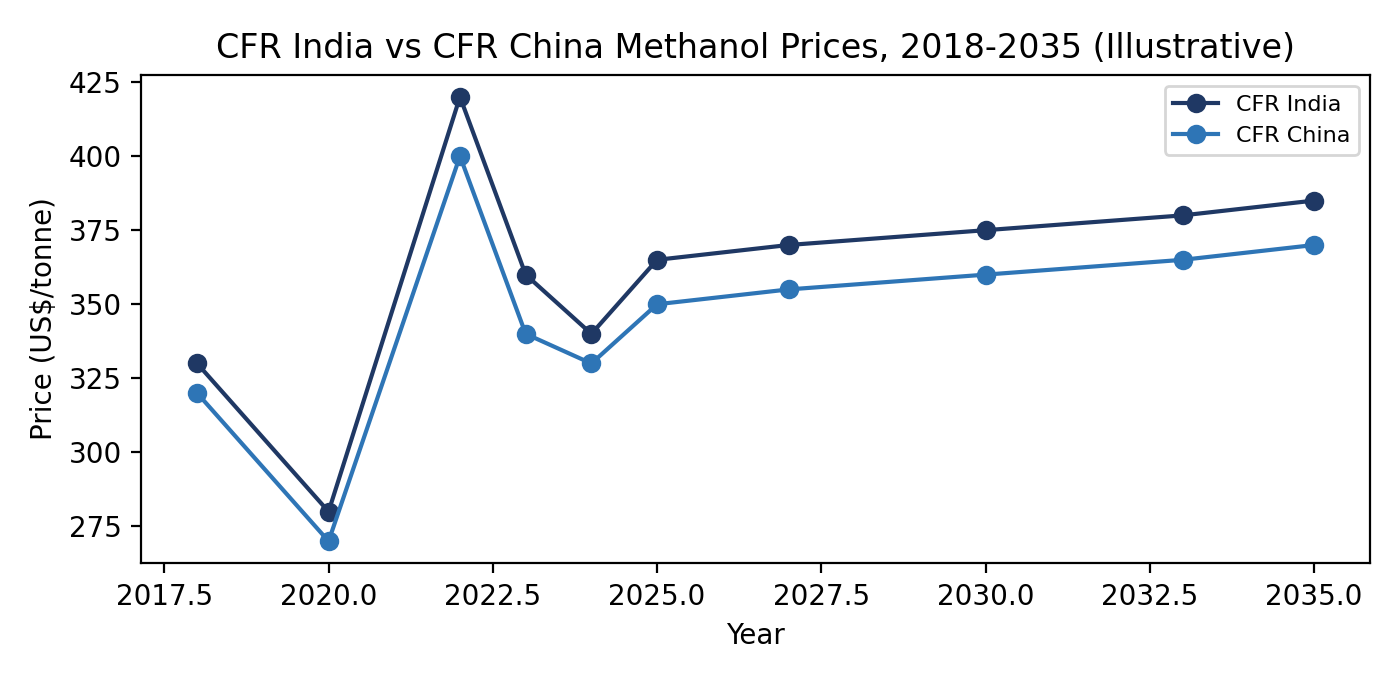
Chart 4: CFR India vs CFR China Methanol Prices, 2018-2035 (US$/tonne, Illustrative)
6. The Emerging Green Methanol Dimension
China is advancing green and bio-methanol projects alongside marine fuel infrastructure, positioning itself as a future hub for low-carbon methanol production and bunkering. The shipping sector's maritime decarbonization push with a growing orderbook of methanol-fueled vessels is creating new demand centers at major bunkering ports, particularly across China and Singapore.
Whether green methanol creates new China-India trade corridors will depend on the pace of India's own green methanol capacity development versus its ability to import low-carbon cargoes. China's investments in green methanol and marine-fuel infrastructure are likely to influence regional trade dynamics over the next decade, potentially adding a new, premium-priced layer to existing conventional methanol flows rather than displacing them in the near term.
.png)
Chart 5: Asian Methanol Demand Growth Outlook, 2025-2030 (Illustrative)
7. Implications for Prices and Market Participants
Traders
Route volatility creates recurring arbitrage opportunities between CFR India, CFR China and FOB Middle East values, rewarding traders with strong freight risk management capabilities and flexible inventory positioning across regional hubs such as Singapore.
Importers
Indian and Chinese buyers increasingly prioritize supply security through supplier diversification, building procurement strategies that can flex between Middle Eastern, Southeast Asian and opportunistic Chinese cargoes depending on prevailing disruptions.
Producers
Middle Eastern producers must weigh export competitiveness across both Indian and Chinese markets, while Chinese producers face margin optimization decisions between domestic MTO supply and export opportunities considerations that increasingly factor into capacity expansion planning across the region.
Overall, route volatility has become a structural feature of Asian methanol price formation, with disruption risk now embedded in pricing relationships that were once driven primarily by underlying supply-demand fundamentals.
Outlook: The Future of China-India Methanol Trade
Key questions for the years ahead include: will China become a regular, rather than opportunistic, exporter to India? Can India meaningfully reduce import dependence through domestic capacity additions, or will demand growth continue to outpace supply? How will Middle Eastern export availability evolve amid both demand growth at home and continued sanctions risk around Iran? What role will green methanol play in reshaping trade patterns, and how significant will geopolitical risks around the Strait of Hormuz and Red Sea remain to future flows?
2026-2030
India's methanol demand should continue growing faster than domestic supply, sustaining import dependence even as the supplier base diversifies further across China, Russia, Southeast Asia and Middle Eastern origins. Trade routes are likely to remain fluid, with opportunistic China-India flows recurring whenever Middle Eastern supply to either market is disrupted, and freight markets continuing to amplify short-term arbitrage swings.
2030-2035
By the early 2030s, green methanol adoption particularly tied to marine fuel demand in China and at regional bunkering hubs should add a new layer of trade activity alongside conventional flows. New production centers, potentially including expanded Middle Eastern and Indian capacity, could gradually reduce the frequency of acute regional shortages, though decarbonization-driven demand growth for low-carbon methanol may offset some of this easing. Long-term trade shifts are likely to favor a more diversified, multi-origin supply structure for both China and India relative to the historically concentrated patterns of the past decade.
In the bullish scenario for trade fluidity, continued geopolitical disruption and strong Indian demand growth keep China-India flows a recurring feature, supporting freight and trading margins. In the bearish scenario, successful Indian capacity expansion and a durable resolution to Iran-related sanctions reduce the frequency of disruption-driven arbitrage, narrowing the opportunities that have characterized the market in recent years.
Strategic Takeaway
Methanol trade flows between China, India and the Middle East have become structurally more dynamic, with disruption risk now a persistent input into price formation rather than an occasional shock. Traders should maintain flexible positioning across regional hubs, importers should continue building diversified, resilient supplier portfolios, and producers should factor route volatility and emerging green methanol demand into long-term capacity and market strategy decisions.
Note: Figures presented in charts throughout this article are illustrative analyst estimates synthesized from the sources above to depict directional trends; readers requiring precise trade flow, price and capacity figures should consult primary data providers directly.